Enterprise AI Agents Don’t Always Need Multi-Agent Architectures
A while ago I reviewed a real AI customer-reception system and ran into a point that is easy to miss:
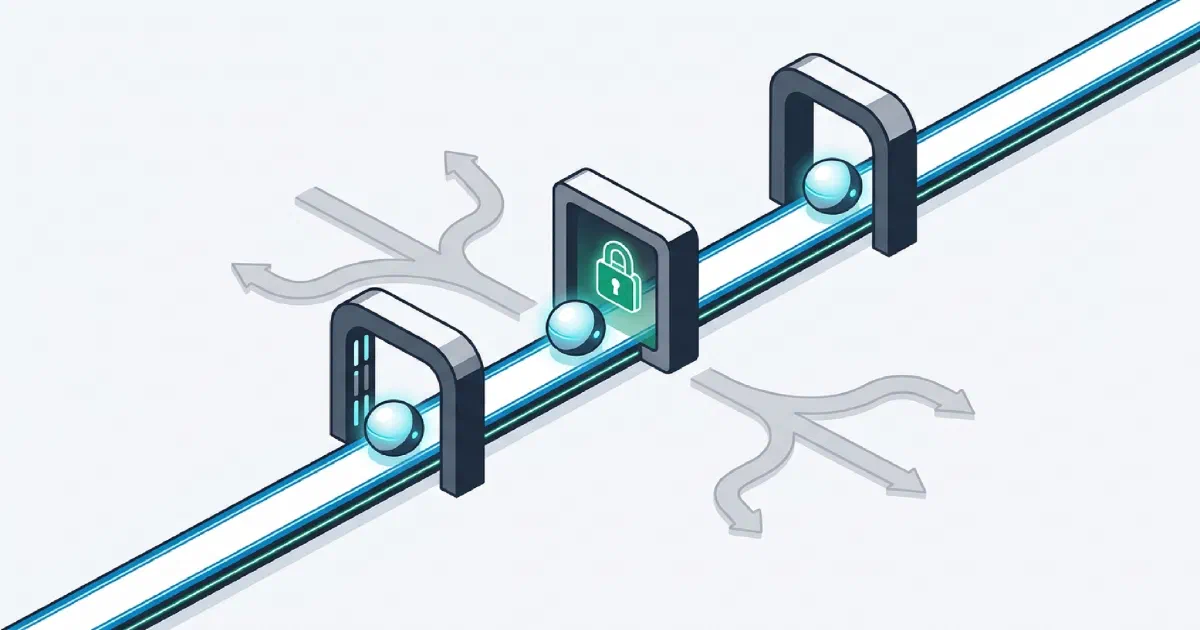
In many enterprise workflows, the most useful agent architecture is not several agents collaborating with each other. It is one agent constrained by a stable process.
The surrounding system should first tell the agent:
- which business stage it is currently in;
- what this stage is supposed to accomplish;
- which tools are available;
- what conditions allow a transition;
- when the workflow must stop and hand over to a human.
I usually call this an SOP agent.
The point is not to make the model less capable. It is to keep the model working inside the right boundary.
What an SOP agent is
An SOP agent places an LLM inside a business workflow.
In this architecture, the LLM is mainly the interpretation and expression layer. It understands what the user says, generates a natural response, and can suggest a likely next step.
But whether the workflow may change stage, whether the system may proactively contact a user, or whether a high-risk tool can be called should be controlled by the state machine, rule system, and business arbitration around the model.
That is different from giving a model one long prompt and telling it to “follow the process.”
Real business state survives across conversations. Users return later. Tools have different risk levels. Those concerns cannot safely live only inside the context window.
Why not every enterprise workflow needs multiple agents
When people talk about agents today, a common mental model is something like Deep Research: a lead agent decomposes a task, several sub-agents search in parallel, and the system combines the results.
That architecture is useful. Open-ended research, unfamiliar industries, and complex information gathering can benefit from parallel agents because you do not know in advance how much material you will need or where the gaps will appear.
But a lot of enterprise work has a different shape.
Customer reception, pre-sales conversations, order handling, after-sales follow-up, and complaint routing are difficult not because the system needs more information, but because the process cannot drift.
A user arrives and the system needs to identify the request. If the user shows interest, it may need to confirm key information. If the user asks a concrete question, the system may need to query a knowledge base or order system. When the user is close to a purchase, the workflow may need to handle objections. If the user becomes unhappy, the system needs to switch to de-escalation or human escalation.
If all of that is left to a free-running agent, the agent may advance too early, ask for information the user already provided, call the wrong tool at the wrong stage, or continue a sales flow after the user has already become dissatisfied.
This kind of workflow does not need more freedom. It needs more reliable process control.
In process-driven work, state comes first
Many agent discussions focus on planning: give the agent a complex task, let it break the work into steps, call tools, and adapt to the results.
That matters for research. In process-driven business work, a more fundamental question is whether the system knows where the user currently is in the process.
A customer rarely finishes everything in one turn. They may ask a few questions today, return tomorrow, place an order three days later, and come back a week after that for after-sales support.
Each of those moments has state:
- which facts the customer has already provided;
- what they care about;
- whether a proposal has been confirmed;
- whether payment has happened;
- whether they expressed hesitation;
- whether follow-up is needed;
- whether the case has entered human handling.
If all of this state exists only in the model context, the system will eventually lose control. Context grows, gets compressed, gets truncated, and can disappear across model changes or service restarts.
A more stable design externalizes the state.
The system loads the current conversation state from a database, tells the agent which SOP it is in, which step has been reached, which facts are confirmed, which questions remain unresolved, and which tools are currently permitted. The agent then handles only the current response inside that context.
The principle is simple:
Do not ask the LLM to remember the process. Make the system remember the process.
One agent with SOP routing
For process-driven work, I usually would not begin by creating separate reception, sales, order, after-sales, and complaint agents.
The user’s conversation is continuous. It does not follow your internal role boundaries. A user can ask about an order during a pre-sales conversation, revisit solution details during after-sales support, or combine a new request, an objection, and an emotional reaction in one message.
If every role is a separate agent, you immediately add context transfer, role switching, tone consistency, and ownership problems.
A simpler approach is to keep one primary agent and use SOP routing to control its current operating mode.
The business workflow is split into stages. Each stage has its own objective, completion conditions, available tools, and transition rules.
The same agent therefore sees different system instructions, different tools, and different goals depending on the active stage.
It is still one agent, but the current SOP constrains its behavior.
Do not hand all intent detection to the LLM
Every user message raises the same questions: what does this mean, should the workflow change stage, should a tool run, and should the conversation escalate to a human?
Many systems hand all of that directly to the LLM. I would not.
Real business workflows contain plenty of deterministic events that do not need model judgment. Phrases such as “check my order,” “I want a refund,” “transfer me to a human,” or “stop contacting me” should often match rules directly.
Rules are fast, cheap, stable, and do not vary with model behavior.
Other expressions make little sense without context: “what about this one?”, “anything else?”, “I’ll think about it,” or “can you take a look?” Those cases need an LLM classifier that sees the current stage, conversation history, and user state.
A more stable structure has three layers:
- Hard Rules for deterministic events.
- LLM Classifier for semantically ambiguous expressions.
- State Arbiter for final system-level arbitration.
The third layer is critical.
The model can suggest moving to the next stage or escalating to a human, but the system should not accept every suggestion automatically. It still needs to check confidence, prerequisites, whether the transition is legal from the current stage, whether risk flags exist, and whether required facts are missing.
The model interprets. The system decides.
Expose tools by stage
An agent being capable of calling a tool does not mean it should see every tool.
If every tool is exposed at all times, the model has to choose from a large list. It may query an order when it should not, search the knowledge base when it should escalate, or call a pre-sales tool during an after-sales case.
A more reliable design exposes a tool allowlist per SOP stage.
The current stage determines which tools are visible:
- an information-collection stage can record facts;
- an order stage can query order data;
- a knowledge-explanation stage can search the knowledge base;
- an after-sales or complaint stage can create a ticket or escalate to a human.
If a tool should not be used in the current stage, do not place it in the model context.
Tools should also have risk levels:
- reading information is lower risk;
- writing state is higher risk;
- user-visible actions are higher risk again;
- payments, refunds, complaints, and sensitive promises should go through approval or human escalation.
The goal of an enterprise agent is not unlimited autonomy. It is autonomy inside authorized boundaries.
Messaging infrastructure matters too
Many demos handle one simple loop: the user sends one message, the AI sends one response.
Real customer reception does not look like that.
Users may send several messages in quick succession. If the system processes each message independently, the agent may start replying before it has the full question.
The input side therefore needs message aggregation so that several short messages sent close together can be combined into one complete input.
AI responses also do not always belong in one large message. An output delivery queue can handle splitting, delay, retry, deduplication, and delivery failures.
Proactive follow-up needs the same discipline. The model should not decide on its own when to interrupt a user.
A rule layer should first check whether the current time is allowed, whether the cooldown period has passed, whether the user was already contacted that day, and whether the user previously asked not to be contacted.
Rules decide whether to send. The model decides how to say it.
The hard part is traceability and recovery
Building a demo that works once is not difficult.
The difficult part is running it for weeks or months in a real business and still being able to explain why a decision happened.
For every user-message cycle, a production system should record:
- the conversation state at the time;
- the intent-classification result;
- which tools were visible to the model;
- which tools were actually called;
- tool results;
- whether the state advanced;
- whether quality checks passed;
- the final content sent to the user.
Without this trace, debugging becomes guesswork.
If a customer says, “the AI made a promise it should not have made,” you need to know which turn, which SOP, which prompt version, which model, and which tool result led to it.
If the business team changes an SOP and conversion gets worse, you need to be able to replay historical conversations and identify whether a stage completion condition was wrong.
Enterprise agents cannot be managed only by tuning prompts by feel. They need traces, evaluations, version management, staged rollout, and rollback.
Where multi-agent systems fit
I am not against multi-agent systems. They are useful when placed in the right part of the architecture.
Open-ended research, code repair, complex data analysis, and long-document review can benefit from specialized agents.
Background work is also a good fit: analyzing historical conversations, finding churn points, organizing the knowledge base, proposing SOP improvements, reviewing complex complaints, or generating operational reports.
But the real-time customer-facing path should not be the first place you split the system into several agents.
The mainline workflow needs to be stable. Background analysis can be complex.
Those are different problems.
Conclusion
Open-ended work has unpredictable paths and benefits from parallel exploration. That is where multi-agent systems make sense.
Process-driven business work has a more stable path but complicated language, long-lived state, many tools, and higher operational risk.
For that kind of workflow, I prefer:
one agent for interpretation and generation, SOPs for workflow control, tool allowlists for permission boundaries, a database for long-lived state, rule systems for outreach and risk control, and an evaluation system for continuous iteration.
It is not the flashiest architecture.
It is much easier to put into production.
Comments