ChatGPT Plus vs Team/Business: A Real-World Usage Capacity Test

Current-status note — September 30, 2026: this article is a historical usage test from May 11–12, 2026, not a current official quota table. ChatGPT Business has since introduced Standard and Premium seats. OpenAI’s current documentation says Premium includes 5× the usage of Standard and is not subject to the five-hour usage window. The Plus-A / Team-B / Team-C ranking below describes only the three accounts I measured at the time. For current limits, check OpenAI’s Business models and limits documentation .
In May 2026, discounted ChatGPT Team/Business workspaces were appearing in several regions. One UK offer I saw was roughly £11 for two seats, or about RMB 50 per seat, which was even cheaper than the Turkish-region Plus subscription I was using as a reference.
That led to an obvious question:
Was Plus actually more durable than Team?
I happened to have one Plus account, which I will call Plus-A, and two Team/Business accounts, Team-B and Team-C.
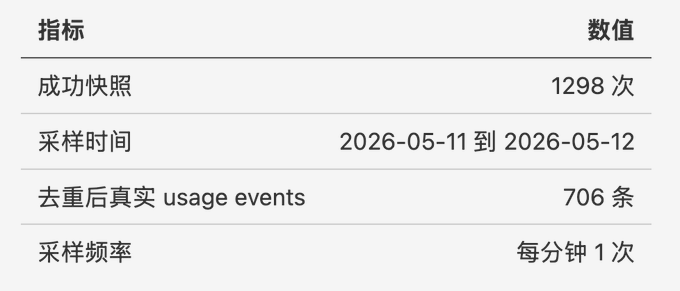
I ran a local automatic sampling script for a day and captured usage snapshots across both the five-hour window and the weekly window.
To be clear, this article is about account durability, not model quality and not official account limits.
Here, “durability” means the effective amount of usage an account appeared able to carry, inferred from the real usage cost and the percentage of the window consumed.
Result
For this specific local snapshot sample, the ranking was clear:
Plus-A > Team-B > Team-C
Three things stood out:
- Plus-A was materially stronger in both the five-hour and weekly windows.
- The two Team/Business accounts were relatively close, but Team-B consistently came out ahead of Team-C.
- Accounts of the same subscription type did not behave identically; different workspaces showed different effective capacity.
If I looked only at high-frequency single-user capacity in this sample, Plus-A was the better primary account. Team/Business made more sense as a collaboration workspace or supplementary capacity.
That conclusion has a strict boundary.
It only describes these three accounts, between May 11 and May 12, 2026, under the model mix and usage pattern I had at the time.
Different accounts, regions, workspaces, models, and usage patterns can produce different results.
Data source
The data came from usage snapshots collected by a local automatic sampling script.
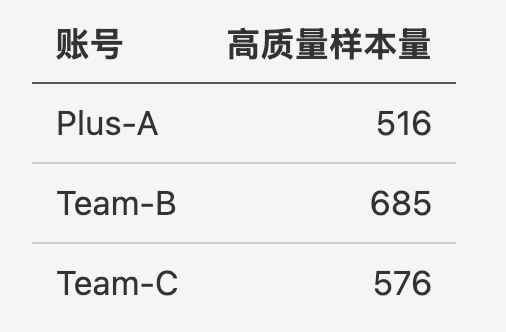
After removing noisy samples, the high-quality sample counts for the three accounts looked like this:
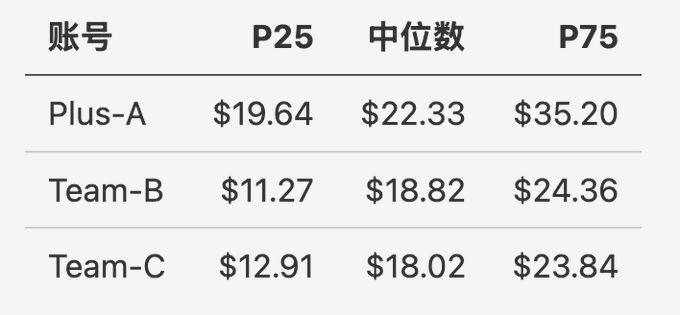
Five-hour window capacity
The following chart shows the P25, median, and P75 of the inferred five-hour capacity.
I also looked at the latest real five-hour window that had fully played out:
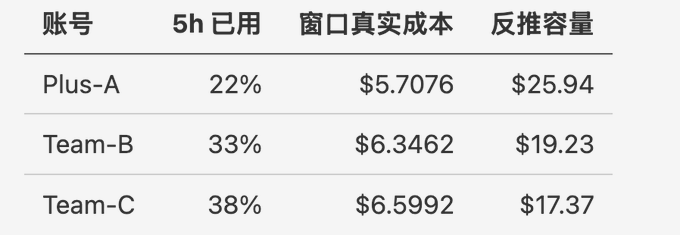
In that window, Plus-A consumed a smaller percentage while carrying an actual usage cost close to the Team accounts.
That naturally produced a higher inferred capacity.
The gap between Team-B and Team-C was not huge, but the ordering matched the broader distribution.
Weekly capacity
The weekly result pointed in the same direction as the five-hour data.
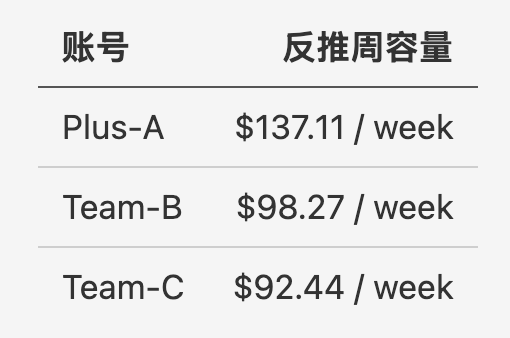
The weekly ordering remained:
Plus-A > Team-B > Team-C
That mattered to me because a lead in only one five-hour window could simply be a lucky slice of time.
Seeing the same ordering in the weekly window suggested the Plus-A advantage was not limited to one short interval.
To avoid relying only on averages or medians, I also compared shared high-quality windows pairwise.
Across 497 shared high-quality windows:
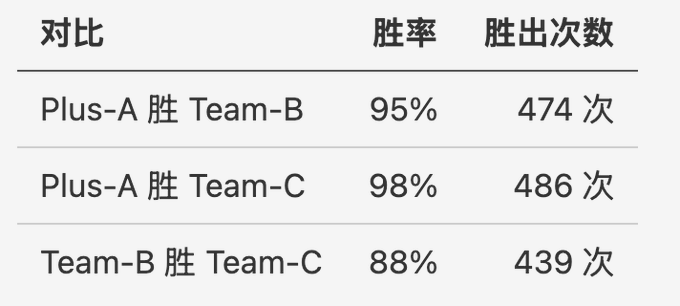
That made the result less likely to be an occasional lead.
Plus-A consistently beat both Team/Business accounts in this dataset, while Team-B also held an advantage over Team-C.
Pricing context at the time
The price comparison below is May 2026 context, not a current pricing guide.
At the time I was writing:
- Turkey-region Plus: about ₺499.99/month through a Turkish Apple ID and gift cards, roughly RMB 78–100 depending on exchange rates and gift-card pricing.
- Team/Business: regional promotions varied. The UK offer I saw was about £11 for two seats, while a US offer was around $20 for two seats.
If the only criterion had been my observed single-user capacity in that sample, Plus was the better primary account.
But Team/Business was not pointless.
Its value included collaboration space, seat management, and extra capacity. What the test did not support was the blanket assumption that a Team/Business account must always be more durable than Plus.
What I would take from the test
The useful part of this experiment is not the old plan ranking.
The useful part is the measurement method and the reminder that the subscription label alone did not fully describe what I observed.
Two Team/Business workspaces were not identical, and the Plus account behaved differently again.
For this May 11–12, 2026 sample:
Plus-A > Team-B > Team-C.
For any current account or current seat type, I would measure the account I actually use and compare that data with the current official limit documentation instead of applying this historical ranking directly.
Comments